
A Book That Takes You Behind the Walls of Hansen Hospital’s Hidden History
Featuring captivating research and rare historical images, offering a window into Hansen Hospital’s past and the lives within its walls

Featuring captivating research and rare historical images, offering a window into Hansen Hospital’s past and the lives within its walls

Imagine growing up behind the walls of a magnificent yet mysterious institution—one that fascinated, mystified, and even terrified the people of Jerusalem. Shunned and avoided by many, this architectural marvel was home to a teenager
searching for her identity...
Imagine growing up behind the walls of a magnificent yet mysterious institution—one that fascinated, mystified, and even terrified the people of Jerusalem. Shunned and avoided by many, this architectural marvel was home to a teenager
searching for her identity...
In the 1960s, the author, Rivka G. Regev, MSW, spent her youth within the walls of Hansen Government Hospital. In this poignant memoir, she peels away layers of myth and misunderstanding surrounding this enigmatic place. Through captivating research into its history, architecture, patients, and staff, she takes readers on a journey of personal and historical discovery.

Photo by Mike Horton
Rivka G. Regev, seen with the plaster model built in Germany in 1912, now permanently exhibited at Hansen House Museum.
This is my story, as well as I can remember it. These are my experiences and insights gained over many years of living on the hospital grounds and from my research together with others.
Readers’ Reviews
Rivka Gita Regev’s My Wanderings in the Gardens: The Legacy of Hansen House in Jerusalem blends memoir with history to trace the transformation of Hansen House from a leprosy asylum to a cultural landmark. The personal journey from an emotionally affected young daughter-of-the-doctor, who spent her formative years within the walls of this unique establishment, to a mature professional clinical social worker is inspiring. Furthermore, the book with its archival documents, and many photographs, brings forgotten voices and spaces back to life. It is both intimate and historical.
Ruth Wexler
Head Nurse at Hansen Hospital, Jerusalem 1988-2009
Of all the books I have read in my now eight decades on the planet, I am quite certain that none has caught me so entirely off-guard as this. I did not anticipate that it would take on almost a devotional quality, the reading of which somehow brought me into times and places that were lifegiving, filled with purposeful hope in the midst of a world that desperately needed it not only during the times the story of Hansen House spanned but every bit as much as the very days in which I sat and read in the gentleness of the early morning hours.
This is a book of the Outsider. It is also a book of the journey home. A book Of Outsiders. For Outsiders. By Outsiders. Even the central character in this story, Hansen House, is an Outsider, its very presence a reminder of society’s failure to care for its own. Its story comes alive in extensive excerpts from the goldmine of archived wealth of letters sent to the Moravian headquarters in Herrnhut, Germany from the directors and nursing staff describing in vivid, sometimes tragic, sometimes hilarious, yet often matter-of-fact detail just how it was to live, work, and care for, as foreigners in a land not their own, those whom no one wanted to be near. Woven into the reports and letters were often the stories of the Hansen’s patients themselves, reminding the reader that these were real flesh and blood people who laughed, cried, and loved, even as their own bodies were disintegrating. As a Christian missionary, serving for half my life in a land not my own, the story of Hansen House brought this outsider a little closer to home.
Dr. Jeri Gunderson
Christian missionary, theologian, educator, and social activist.
From the very first pages of My Wanderings in the Gardens: the Legacy of Hansen House in Jerusalem, Rivka Gita (Goldgraber) Regev’s love for the Hansen compound - the residents, the building, its garden, paths, hidden corners, water supply, cisterns - is present throughout the book. She takes us along an outstanding personal and general wandering through history, empathy, and healing. Through careful research she brings to light a place and its community, giving the reader the feeling of its special atmosphere.
The empathy for the residents of the leprosy asylum is compelling. The author brings forward their voices with care and respect, and her relationships with some of them lend the book a quiet emotional depth. Her writing battles the stigma surrounding leprosy using attentive storytelling and human connection.
The book draws on a rich collection of archival materials - medical reports, letters, and personal accounts - which are integrated into the narrative. These excerpts offer rare insight into daily life at the asylum during the 19th and 20th centuries, giving voice to experiences that are often left out of official histories.
My Wanderings in the Gardens is a carefully composed work of research, memory and meaning. It honors Hansen House not only as a historical site, but as a space of quiet endurance, humanity, and hope.
Hanna Melchior
Occupational therapist, employed at Hansen House/ Hansen Clinic 1992-2012
What a fascinating book!
Regev, who grew up at Hansen Hospital, records not only her memories. She fully details the history of the hospital, adding background on the Moravian church that founded the hospital in 1867. Regev includes information about Hansen’s disease, formerly and incorrectly thought to be the Biblical leprosy. Regev describes the layout of the building compound, its water reservoirs, gardens, toilet facilities, bakery, etc. She lovingly portrays staff members and patients and provides descriptions of patient trips to the Jordan River and other Biblical sites. Regev travelled to Germany and the USA to meet former staff members and gather archival material.
Finally, Regev reports on her efforts to preserve the compound and see it converted into a community cultural center.
Regev’s well-researched book can serve as an original first-hand source for anyone seeking information on Hansen hospital and the people who lived there.
Ellen Rosenberg
Tour guide
This is a delightful book. I read it over the course of just a few days and found it utterly absorbing. It’s wonderfully descriptive, lovingly and meticulously researched, and the pictures and maps are stunning. Buy it, pop it in your bag next time you visit Hansen House and use it to unlock the secrets of those magnificent buildings and grounds.
Carol Sutherland
Translator
Explore the Untold History of Hansen Hospital
The book features rare historical images of Hansen Hospital, offering a window into its past and the lives within its walls.

Hansen's disease patients
at the Jesus Hilfe gate, 1887

The Jesus Hilfe herd of dairy cows,
1903

Schuberts and Sisters on the central courtyard cistern, 1906
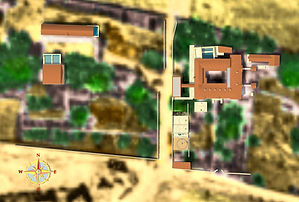
All nine Jesus Hilfe cisterns, 1909; Image and computer-generated models by Mike Horton

Some patients and staff of Hansen Hospital, 1980 Photo courtesy of the late Yakov Kadosh

The Hansen Hospital and front gardens seen from the southwest, 2009
Photo by Mike Horton

Karl Schubert on the balcony,
Jesus Hilfe Gardens, 1896

Karl Schubert with children
and animals, 1904

The cows grazing in the new Jesus Hilfe western plot, 1907

L-R Sitting: Anna Maria Schubert (mother and daughter) Standing: Johannes, Willy, Elizabeth Schubert, circa 1915 near Herrnhut, Germany

November 2023 farmer's market at Hansen Gardens after October 7 massacre, Photo by Mike Horton

Rivka's Father at Hansen Hospital, 1998 Photo by Meir Stern
%20and%20Hansen's%20disease%20patients%20excavating%20to%20build.jpg)
Housefather Schubert in upper left corner, excavating with the stronger patients, to make cistern, 1898

New Jesus Hilfe Jerusalem Asylum carriage with the Schuberts and
Sisters, 1906

Jesus Hilfe, plant nursery, bakery and water system, 1907

View of Jesus Hilfe from southeast,
1920's

Rivka G. Regev explaining cisterns 5 & 6 as illustrated in her book on pages 174-175. Photo by Israel Galon

Elizabeth Schubert's postcard,
1912